
The Story of Zhong Kui
In Tang Zhong Kui Quanzhuan, Zhong Kui is the son of Zhong Hui and Lady Tan, born after years of prayer and charitable works. He grows into an upright scholar and receives a divine brush and sword. After the human court rejects him despite his examination success, he dies and is summoned to Heaven. He examines the records of the underworld, corrects an unjust judgment, and is appointed Marshal Who Governs Yin and Yang and Quells Demons. The novel later has the emperor see him in a dream and order his protective image to be sent throughout the realm.
Before Zhong Kui Was Born
Before Zhong Kui was born, his father Zhong Hui—styled Dewei and known as Master Shishi—lived with his wife, Lady Tan, in Haizhou. Zhong Hui came from a family of Confucian learning and had held distinguished office, but because the couple had no son, he withdrew from public life. He admired the ideals of the sage-kings Yao and Shun and revered the lofty conduct of Boyi and Shuqi. He regarded wealth and rank as drifting clouds and cast aside official cap and carriage like worn-out shoes.
It was the middle of spring. The landscape was flourishing and the light of the season was bright. One day Zhong Hui said to his wife, ‘Spring is upon us and we have a little leisure. I would like to go with you to the Pavilion of a Hundred Flowers. What do you think?’ Lady Tan replied, ‘That would be delightful. I shall go with you.’ They ordered the servants to prepare wine and food and went together into the garden.
There they saw brilliant flowers and fresh green plants. Mandarin ducks nestled neck to neck beside the pond, while pale butterflies courted among the branches. Distant mountains rose blue through the haze, and green water rolled in waves. It seemed a paradise within the human world, and husband and wife were filled with joy.
Then Zhong Hui saw birds feeding their young and wild geese flying in ordered ranks. The sight stirred his heart. ‘Even birds care for their offspring,’ he said. ‘Can a human being be less than a bird? Half my life is gone and I have no son. I possess a fortune of ten thousand strings of cash, but who will inherit it? As the old saying goes, “Of the three forms of unfilial conduct, leaving no heir is the gravest.”’ Their pleasure in the wine vanished, and they returned home in sorrow.
From that time the couple carried this grief constantly. At last Zhong Hui said, ‘Grain may fill our storehouses and money may decay on its cords, but without a child it is all in vain. Heaven answers a sincere good intention. Let us give our wealth in charity and relieve the poor. Even if we never have a son, good will surely come of it.’
Lady Tan agreed. She proposed that they purify themselves, fast and bathe, invite Buddhist and Daoist clergy, and go to sacred Mount Hua to pray for a child. Zhong Hui chose an auspicious day. For seven days and nights they worshiped with complete sincerity. Afterward they continued to give wherever they could: repairing bridges, building temples, adorning sacred images and aiding the poor. Widowers, widows, orphans and the childless all received their help, and everyone in the district honored them.
One night Lady Tan dreamed that a warrior in golden armor approached carrying a red sun. She snatched the sun and swallowed it. When she woke, she told her husband. Zhong Hui said, ‘This must be a sign that we shall have a son. Our ancestors practiced goodness, and throughout our lives we too have given to others. Heaven has taken pity on us and sent you this dream.’ Several months later Lady Tan knew that she was pregnant.
As the birth drew near, she became exhausted and restless. One day the pain grew severe and she fainted. Zhong Hui cried out and shook her awake. Lady Tan opened her eyes and said, ‘I dreamed that five-colored incense smoke coiled around my body. When I tried to brush it away, a divine voice said: The child you carry is the Wuqu Star of the upper realm, descended to be born through you. One day he will attain his rightful divine station, and blessings will come of themselves. Why do you drive him away?’
Soon afterward Lady Tan gave birth to a boy. Radiant light filled the room and purple vapors rose around him. The household bathed the child in fragrant water and summoned a nurse to care for him.
The White Rat Enters the Room
The next morning the entire household rejoiced, and relatives arrived to offer congratulations. Zhong Hui laid out a feast. Halfway through the drinking, a white rat suddenly ran into Lady Tan's room, astonishing the guests.
At that moment two monks entered the central hall, scriptures in their hands and the name of Amitabha on their lips. Zhong Hui asked why they had come. ‘We heard that Master Zhong has been blessed with a qilin son,’ they replied, ‘and we came especially to congratulate you.’ Their bearing was dignified and their speech extraordinary, so Zhong Hui warned the guests not to treat them lightly.
He invited the monks to the seats of honor and asked them to explain the white rat. ‘Its entrance is an auspicious sign,’ they said. ‘Your son will one day answer to the omen of the White Dragon. Bring him to us so that we may see him.’
Zhong Hui carried out the child. The boy's face was unusual and his form unlike that of an ordinary infant. The monks stroked his head and exclaimed, ‘Excellent! Excellent! All virtue has gathered in this child. One day, will he not govern the hauntings beneath Zhong Mountain?’ With those words they changed into a breath of clear wind and vanished. Only then did Zhong Hui understand that his visitors had been divine beings.
The Child Is Named Zhong Kui
Zhong Hui and Lady Tan rejoiced both in the birth of their son and in the revelation of the divine monks. Lady Tan said, ‘Above, we depend on Heaven and Earth to shelter and sustain us; below, we rely on the protection of the spirits. Now we have a child and our family line has an heir, but he still has no name.’
Zhong Hui considered the matter. ‘You once dreamed that you swallowed a red sun,’ he said. ‘Why should we not call this child Zhong Kui?’ Lady Tan approved.
By the time Zhong Kui was one year old, he could already walk and speak. His father found him remarkably quick and said, ‘This child has a distinguished and refined bearing, entirely unlike the ordinary. One day he will become a strong arm of the court and a pillar of the state. He will honor his parents and ancestors, bring light to our household, extend grace throughout the realm and leave his name in the records.’ Lady Tan asked how he could know such things. Zhong Hui replied, ‘No one knows a son better than his father.’
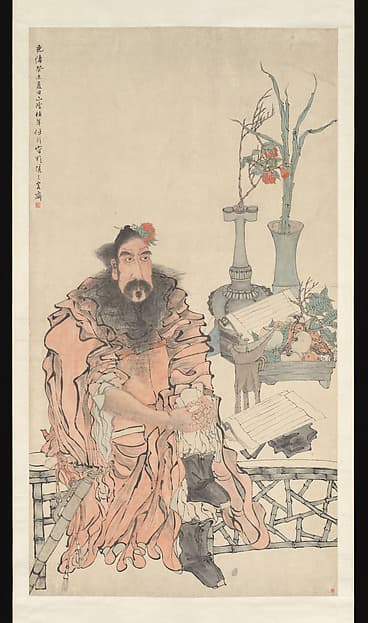
Zhong Kui Is Sent to School
When Zhong Kui was nearly six, Lady Tan said to her husband, ‘Our son is growing. We must send him to a teacher and have him read books. We cannot keep him at home and ruin his future. The old saying tells us that when a child goes uneducated, the fault lies with the father. If we choose a worthy teacher and send him to school for study and discipline, he may become a man of ability, bringing honor both to his ancestors and to his parents.’
Zhong Hui agreed. The best teacher nearby was Zou Xixian, who gathered pupils at the community school and instructed them with method and order. Zhong Hui chose a day, called his son and said, ‘A person who does not learn is no different from a bird or beast. You are old enough now to enter the school and study under a master. Fix your mind upon learning and do not let your purpose grow lazy.’ Zhong Kui respectfully accepted the command. A servant packed his book chest and escorted him to the school, where he bowed to Master Zou as his teacher.
The Young Scholar
Zhong Hui entrusted his son to Master Zou and asked him to guide the boy through confusion and awaken his understanding. The teacher answered modestly, but after looking at Zhong Kui he said, ‘Your son's natural ability will not leave him behind other men. One day he will become a distinguished pupil of the public schools, an indispensable minister at court, an example to his age and an influence upon generations to come.’
Zhong Kui studied at Master Zou's gate. His mind was swift and his understanding natural. One day, as all the pupils listened in the courtyard, the teacher said, ‘To order the family, govern the state and bring peace to the world—all of it rests on the two words cultivate oneself. Do you understand?’ The other students were silent. Zhong Kui alone stepped forward and said, ‘How profound are the master's words!’
Master Zou praised him. ‘You are a complete man between Heaven and Earth. If you fulfill this nature through learning, you may reach the source of the Way and enter the deepest chamber of the sages. Why should you fear that achievement and honor will not come? Apply yourself.’ From then on Zhong Kui advanced day by day. Those outside the school admired him, and his classmates respected him.
A Heart Set on the Realm
Zhong Kui never tired of study. Once, while Master Zou was away, the other pupils played games and traded jokes. A student named Chen Biao asked why Zhong Kui worked so hard. Zhong Kui replied, ‘The learning of the sages has always come from hardship and diligence. No one has succeeded through laziness. If the farmer does not labor, his household stores no grain. If the merchant is not diligent, his purse holds no profit. How much more is this true of our studies?’
Chen Biao asked whether he studied merely to bring fame to his parents and make a name for himself. Zhong Kui answered, ‘It is not only for family fame. A person born between Heaven and Earth should possess a loyalty bright enough to pierce the sun and an integrity that rises above frost. His heart should withstand the judgment of Heaven, Earth and the spirits. His conduct should contend in brightness with the sun and moon, and his name should endure as long as the world. Only then can he stand without shame among men.’
When Master Zou returned and heard these words, he declared that Zhong Kui's purpose surpassed that of ordinary people. He offered the boy a matching-line challenge: ‘A child of three feet must fill his memory with the Odes and Documents.’ Without pausing, Zhong Kui answered: ‘With one point of loyal heart, I wish only for peace in home and realm.’ The teacher praised him without reserve.
Several days later, during the Dragon Boat Festival, the pupils slipped away to watch the races. Drums and music shook the sky, and voices filled the earth. Everyone delighted in the spectacle except Zhong Kui, whose face remained sorrowful. Asked why he alone found no pleasure, he said, ‘The dragon boats were established to mourn Qu Yuan. When I see them, tears rise before I know it. Where is the joy in that?’
That evening Master Zou reprimanded the pupils for leaving their studies and demanded a matching line as the price of forgiveness: ‘Dragon boats race upon the river to decide victory and defeat.’ The others stood speechless. Zhong Kui stepped forward and replied: ‘Before the palace, the examination list ranks every candidate from high to low.’ Astonished, the teacher called him a prodigy rarely encountered in a thousand years.
The Jade Emperor Tests Zhong Kui
After four years under Master Zou, Zhong Kui returned home. Believing that his son needed a more accomplished teacher, Zhong Hui sent him to the Xizhai Academy to study under Yu Nanhua, a retired scholar renowned for his knowledge of the classics. Zhong Kui studied there for nearly two years and quickly distinguished himself among the other students.
When Zhong Kui had grown and continued his studies at the Xizhai Academy, the Jade Emperor, ruler of Heaven, spoke before his assembled ministers. Zhong Hui and Lady Tan, he said, had long practiced goodness and secretly accumulated merit. A heavenly messenger had already been sent to give them a son, whom they had named Zhong Kui. Now that the boy was grown, the Jade Emperor wished to test his conduct before entrusting him with a great responsibility.
The superintendent of the palace registers volunteered. Descending to the academy late at night, he transformed himself into a beautiful woman dressed in silk and jewels and knocked on Zhong Kui's door. Believing the visitor to be another student, Zhong Kui opened it. At the sight of the woman he started back and cried, ‘What demon are you, coming here at this hour to take my life? Leave quickly and I will spare you. Otherwise I shall cut you down with my sword.’
The woman claimed to be a neighbor wandering beneath the clear moon. She said Zhong Kui's reading had drawn her to him and asked to remain as his companion. Zhong Kui answered, ‘I have always guarded my integrity. How could I take part in such a dishonorable act? Go at once, before anyone learns of this.’ Though she pressed him repeatedly, he refused with a stern face. ‘I would sooner die than submit. Such conduct would stain my honor, and Heaven, Earth and the spirits would not tolerate me.’ At last, near the fourth watch, the visitor departed.
The following day Zhong Kui fell asleep over his books and dreamed of a long-bearded warrior in a phoenix-winged helmet and golden armor, holding a register in one hand and a sword in the other. The figure said he was a heavenly spirit sent to investigate good and evil among humankind. Asked why he had come, he replied, ‘To observe in secret what kind of man you are.’
Zhong Kui said, ‘I follow the Way and uphold what is just. I act openly and honestly, without shame, flattery or arrogance. My heart can be shown to Heaven and the sun, and my integrity stands as severe as frost. That is the kind of man I am.’ The spirit answered, ‘Then you are truly an upright man between Heaven and Earth. I shall report your conduct to the Jade Emperor.’ When Zhong Kui woke, he found that it had been a dream.
Soon afterward, Zhong Hui fell gravely ill. Zhong Kui returned home and prayed that he might suffer in his father's place. Moved by his devotion, the Jade Emperor sent a heavenly messenger with a divine pill that restored Zhong Hui to health.
The Promise to Xiuying
When Zhong Hui reached his fiftieth birthday, relatives and officials filled the house to offer congratulations. Zhong Kui joined the banquet. Among the guests was Zhang Xian, a grand secretary and an old friend of Zhong Hui. Struck by the young man's unusual appearance, Zhang Xian asked what books he had read and whether he could compose poetry. Zhong Kui answered that he had studied the histories and classics and possessed some skill in verse.
Zhang Xian challenged him to write for his father's birthday, requiring every line to return to the idea of long life and to the evergreen pine and cypress in the courtyard. Zhong Kui took up the brush and completed the piece without a correction. Zhang Xian read it again and again, praising both its language and the ability of so young a scholar.
He then asked Zhong Hui whether his son had been promised in marriage. When Zhong Hui said no, Zhang Xian offered his own daughter, Xiuying, as Zhong Kui's future wife. Xiuying was sixteen years old and accomplished in poetry, music, calligraphy and painting. Zhong Kui bowed to Zhang Xian as his future father-in-law, and the two families agreed to the match before the assembled guests.
The Divine Brush and Sword
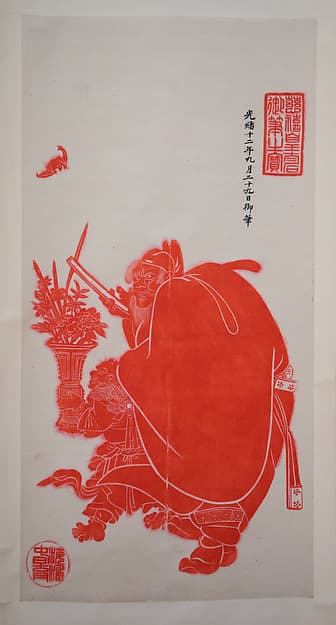
The Jade Emperor took his seat in the celestial hall. When the gods had completed their homage, he summoned a messenger and said, ‘Zhong Kui of Haizhou is firm and upright, and his understanding reaches the spirits. I now grant him one brush and one sword. With the brush he shall record good and evil among humankind; with the sword he shall subdue the demons of the world.’
The messenger descended to the academy, where Zhong Kui was reading. With a single breath he caused the scholar to fall into a trance and appeared in his dream. ‘The Jade Emperor gives you a treasured sword and a divine brush,’ he said. ‘The brush reaches upward to the celestial court and downward to the underworld. Whenever good or evil appears among humankind, record it with this brush. The sword can destroy wicked spirits and subdue every demon of depletion beneath heaven. Whenever a monster appears in the human world, use this sword to conquer it.’ The messenger cast the brush and sword onto the desk and vanished.
Zhong Kui awoke to find a brush and sword lying before him. Astonished and uncertain, he hid them and told no one.
That night demons crowded around the academy and spirits gathered outside his window. Zhong Kui sat beneath a solitary lamp reciting the classics when music suddenly rose and countless figures appeared in brilliant light. He opened the door and found the demons bowing to the ground. Together they cried, ‘Long life to Lord Zhong!’
‘What spirits are you?’ he demanded. They answered, ‘We live for the time being in the old temple nearby. We heard that the Jade Emperor bestowed a brush and sword upon you, and so we came to pay our respects.’ Zhong Kui warned them: ‘Do not harm living people or injure their animals. If you disobey, I shall cut your bodies into ten thousand pieces, and repentance will come too late.’ The demons scattered. From the time Zhong Kui received the brush and sword, the evil beings of the region hid themselves, and the people lived in peace.
The First Examination and the Road to Zhongnan
After the two families exchanged the formal betrothal gifts, Zhang Xian invited Zhong Kui to study in his household. He treated the young man as the son he had never had, while Zhong Kui devoted himself to his books and accepted his future father-in-law's instruction. About a year later, when the autumn examination approached, Zhong Kui took leave of Zhang Xian and Xiuying's mother, returned home to bid farewell to his own parents, and set out for the capital with his servant, books and sword.
On the journey, the divine gifts he had kept hidden began to find their purpose. He destroyed a pheasant spirit that had bewitched a traveler and struck down two stone-horse spirits that had terrorized a village. Near the capital he exposed another creature that had taken human form and sickened one of the candidates. By the time Zhong Kui entered the examination hall, his learning was no longer the only sign that Heaven had marked out a different office for him.
Zhong Kui completed the examination in the capital. When the results were posted the following day, seven men from his lodging had passed. Zhong Kui asked the messenger, ‘Was the name Zhong Kui among them?’ The answer was no.
At these words Zhong Kui collapsed. His servant hurried to revive him with hot water and tried to offer comfort. ‘The proverb says that while the green mountain remains, there will never be a shortage of firewood. You are still young. If you did not succeed in this examination, you may take first place in the next. Do not surrender yourself to grief.’
Zhong Kui replied, ‘I endured ten years of cold nights at the study window for the hope of winning a name in a single attempt, bringing honor to my parents and glory to my ancestors. Now that I have failed, how can I face my father and mother? I will not return home. I have heard that Zhongnan Mountain is one of the finest places beneath heaven and that scholars travel there. Pack my books and luggage. I shall go to the mountain and study until the next examination. Only after I pass will I return.’
The servant reminded him that his aging parents waited anxiously and had no other son to depend upon. Zhong Kui answered, ‘Even the crow returns to feed its parents, and beasts remember the source from which they came. How could a human being be less than birds and animals? It is not that I do not wish to serve my parents morning and night. But without achievement, I am ashamed to return to my old home. This is the grief I cannot speak.’ He ordered the servant to prepare for the journey to Zhongnan Mountain.
Zhongnan Mountain, Death, and the Heavenly Summons
After this first failure, Zhong Kui set out for Zhongnan Mountain instead of returning home. On the road he met an old man named Li Dian, who had been driven from his house by an unfilial son and daughter-in-law. After hearing how the son had caused his mother's death and cast his father out to beg, Zhong Kui gave the old man money and grain. That night he wrote a petition to Heaven, asking that such conduct be punished so that the bonds between parent and child would not be overturned.
At Zhongnan Mountain he continued to devote himself to his books. News then came from home that his betrothed, Xiuying, had fallen ill and died while grieving over his absence. Zhong Kui wept without ceasing. He prepared offerings, composed a memorial for her, and vowed never to marry another. He asked the monks of the mountain to perform rites for her passage. That night he dreamed that golden youths and jade maidens descended with banners to escort Xiuying into Heaven.
Textual note: The surviving Wanli edition is missing pages at this point. Zhong Kui's second examination, rejection, and death are reconstructed from later accounts within the same work.
Zhong Kui remained at Zhongnan until the next examination. This time he won first place. But when he came before the Tang ruler, the ruler was repelled by his appearance and stripped him of the appointment. Unable to bear another return home in disgrace, Zhong Kui struck his head against the palace steps and died. The court gave him a green robe and buried him with ceremony.
His spirit did not sink into obscurity. It went directly to the heavenly court, where the Jade Emperor entrusted him with an inquiry into the records of the underworld. Meanwhile, when Zhong Kui's parents heard of his death, their grief killed them both. Because of the good works they had practiced throughout life, heavenly messengers brought them upward; Xiuying had already been received into the celestial palace. The family was promised reunion when Zhong Kui completed his commission.
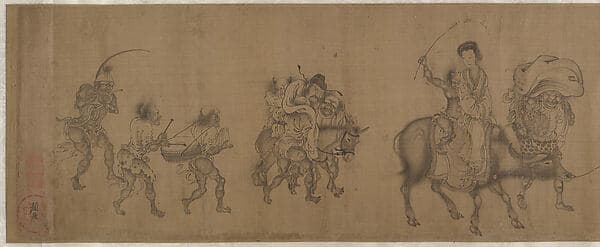
The First Court and the Wrongful Punishment of Li Sheng
Bearing a white tiger-headed tablet inscribed ‘By Heaven's command, examiner of the underworld,’ Zhong Kui descended with celestial attendants to the first court of King Qinguang. He called for the registers of good and evil and read them line by line. One entry named an offender Li Cheng in the working register but Li Sheng in the official copy. Zhong Kui marked the discrepancy for investigation before proceeding to the Hell of Knife Mountain.
There he heard a condemned soul cry that he was innocent. The man was Li Sheng, a dutiful person seized in place of the guilty Li Cheng after underworld officers accepted a bribe. Zhong Kui ordered Li Sheng released back to the world of the living, commanded the true offender's arrest, and demanded punishment for the corrupt officers. His work in the underworld was therefore not merely to witness torments, but to test the records and correct injustice.
The Remaining Courts and the Punishments Zhong Kui Witnesses
He continued through the courts and prisons: the mountains of ice, the place of sawing, the mill, the cauldrons of boiling oil, the stone mortars, the cutting of tongues, the weighing scales, and the wooden donkeys. At each court he inspected the books, questioned officials, and warned that no innocent person was to be punished. While inspecting the third court, Zhong Kui discovered that Li Keyi had been struck by lightning and was being punished for the death of his mother and the abandonment of his father. At the Ghost Gate he saw spirits of every form; at the Terrace of Looking Homeward he saw the dead turn toward the four directions and weep for the world they had left.
The Bridges of Rebirth and the Final Register
Beyond the Yellow Springs road he came to the bridges before the Court of Rebirth. The finest bridge, built of jade and fragrant wood, carried those who had cultivated virtue. Another served those who had done neither great good nor great evil, while the perilous bridge received wrongdoers. At the Bridge of Ascension Zhong Kui met Xiuying's parents on their way to Heaven. After taking leave of them, he inspected the final register, found it in order, and returned to the celestial court with his written report.
Zhong Kui Becomes the Demon-Quelling Marshal
Zhong Kui presented the completed register before the Jade Emperor and reported everything he had witnessed in the underworld. The Jade Emperor summoned his father, mother, Xiuying, and her parents. They met before the Five Phoenix Tower and spoke together after their long separation, then knelt as one family to give thanks.
The Jade Emperor told Zhong Kui that his inspection of the underworld had earned great merit, but demons were rising throughout the human realm and no one was able to subdue them. He gave Zhong Kui an iron tablet for quelling demons and appointed him Marshal Who Governs Yin and Yang and Quells Demons. Zhong Kui received the command, took leave of his family, and returned to Zhongnan Mountain.
The abbot Jiekong saw a figure descend from the sky wearing an official cap and blue robe, a sword at his waist and the iron tablet in his hand. Frightened, the abbot warned all the monks to observe their discipline. That night Zhong Kui appeared in his dream and explained who he was: the former scholar of the mountain, rejected after winning first place, now commissioned by Heaven to sweep demons from the world.
When the abbot awoke, he told the monks what he had seen. They made an image of Zhong Kui and installed it on the mountain, keeping lamps and incense before it. From this point the scholar's private tragedy became a public office: he was no longer seeking recognition from the human court, but carrying authority between Heaven, the underworld, and the homes of ordinary people.
The Emperor's Dream and the Image Sent Across the Realm
During the Kaiyuan reign, the emperor returned from military exercises at Mount Li and fell ill. In a daytime dream he saw a small ghost wearing one shoe, with the other hanging from its belt. The creature stole an embroidered perfume pouch and the emperor's jade flute, then ran laughing around the palace. When challenged, it called itself Xuhao, a wasting ghost that steals valuables and turns a household's joy into sorrow.
The emperor was about to call the guards when a great ghost appeared in an official cap and blue robe, with a sword at his waist and an iron tablet in his hand. He seized the little ghost, tore out its eyes, and devoured it. Asked his name, the great ghost replied, ‘I am Zhong Kui of Zhongnan Mountain, a scholar who placed first in the imperial examination. The Tang ruler rejected me because my face was ugly. In shame I struck the palace steps and died. The court buried me in a green robe. In gratitude for that ceremony, I have come to rid Your Majesty and the realm of Xuhao and other demons.’
The emperor woke and found that his illness had vanished. The next morning, the emperor recounted the dream to his ministers and ordered Zhong Kui’s likeness to be painted. A minister recommended Wu Daozi, whose brush was said to possess divine skill. After hearing the dream, the painter completed the image as though he had seen Zhong Kui with his own eyes.
Delighted by the likeness, the emperor ordered a hall built for it and conferred upon Zhong Kui the title Great Marshal Who Protects the Realm, Aids the People, and Quells Demons. The emperor ordered copies of the portrait to be distributed throughout the realm. At the close of Zhong Kui's biographical arc, the rejected scholar finally enters every household: not through the examination list that denied him, but through the protective image by which his power remains known.